@XBToshion X · 2026-10-30
A tamper-evident, on-chain timestamp of what this post said. Captured 2026-10-31 06:42 UTC.
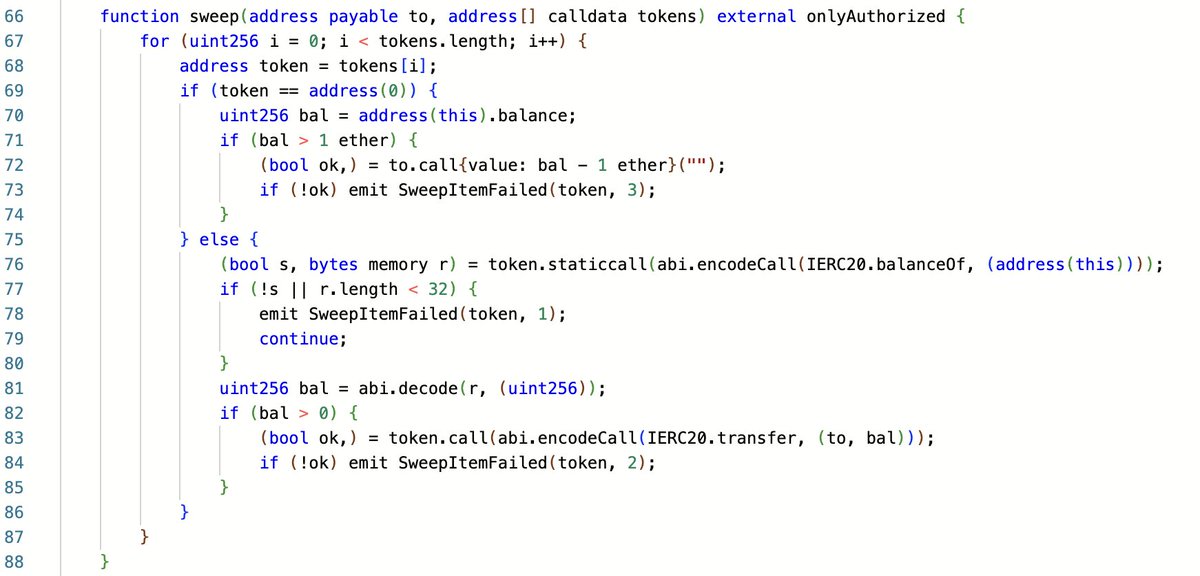
Reading the reconstructed bytecode of the Binance EIP-7702 sweeper (`0x63e8...6fae`) is wild. This wasn't a generic drainer. It was custom-engineered for Binance 14's architecture: - Leaves exactly 1 ether behind (`bal - 1 ether`) when sweeping ETH so Binance's automated hot wallet queue wouldn't error on gas and trip alarms. - Uses raw `staticcall` + `continue` loops with custom error codes (`SweepItemFailed`) so one bricked or blacklisted ERC-20 wouldn't revert the $6B batch. - Includes a custom `callExecute` function to impersonate Binance 14 as controller of an external vault holding $823M in USDC. They leave a comment: "robberies could be prevented if getaway cars were slower." You can't fully blame EIP-7702, but it sped up the attack. Without 7702, draining 64 tokens plus an external $823M vault from a live exchange hot wallet meant fighting moving nonces across 70+ transactions. Defense systems would've killed it after tx #3. With 7702, Lazarus sprayed 50 consecutive nonces in one type-4 payload, turned an EOA into a custom proxy, and atomically swept billions in a single block. Ethereum core devs built the ultimate getaway car. Surgical state-sponsored engineering. This could be etched onchain: `if (bal > 1 ether) { https://t.co/ou2j9VqGvv{value: bal - 1 ether}(""); }`
The Binance $5.6B drain is a masterclass in modern EVM exploitation. It wasn't a complex logic bug. It was an EIP-7702 delegation hijack: 1. Setup: Attacker funds 0x7c86 via Tornado Cash, deploys a sweep contract (0x63e8), and runs three live dry-runs on external wallets. 2. https://t.co/ocevIzUbgJ
This post quote-tweets the one above. Its text and identity are anchored (one level, no deeper); any media it showed is anchored with this post's media. Quoted text may be truncated for a long-form original — the anchored hash covers exactly the text shown here.
Verify it yourself: the manifest is the exact JSON whose
SHA-256 is 9d6279782032142d57b01df2b76224f7cf37db7fbfebfc6ed532cedef2b364ad; it binds the tweet id, author, post time, and the SHA-256 of the text above. Re-hash the text to match 1b3bcf2c54725666716c765329b99e59b4af204b572021d54da823e5bd9d73af, plus the quoted post's id, author, and text hash 976e188fb583fdd36740367b8a754a4cabbf1d6d0870535050ef88a4db54b165, and read the anchor transaction's OP_RETURN
bsv.cx / x1 / 9d6279782032142d57b01df2b76224f7cf37db7fbfebfc6ed532cedef2b364ad — the block's timestamp proves the post said this at or before that time,
with no trust in bsv.cx. Content archived via the X API.