@MetabolicUncleon X · 2026-09-06
A tamper-evident, on-chain timestamp of what this post said. Captured 2026-09-06 23:37 UTC.
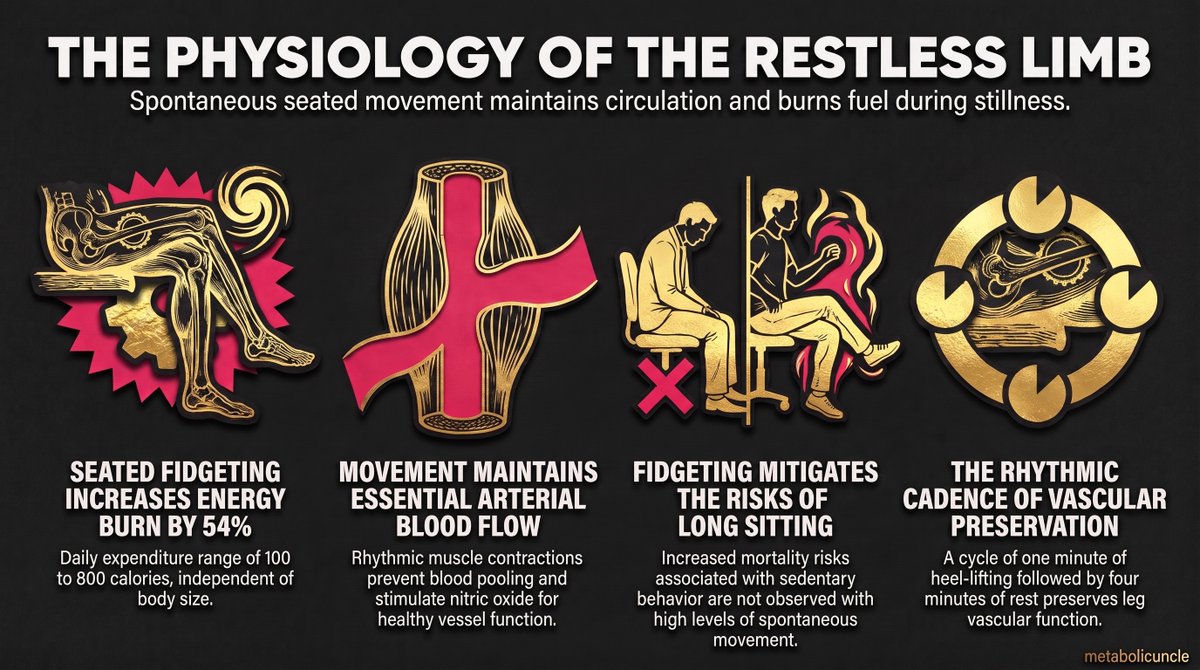
THE LEG BOUNCE AT YOUR DESK IS DOING REAL WORK Your knee starts bouncing under the desk somewhere around hour three, and you catch yourself and make it stop. That twitch is keeping blood moving in your legs and quietly burning real fuel. It looks like nothing, a nervous habit and nothing more. To a teacher, a boss, or your own sense of what focus is supposed to look like, it reads as restlessness that needs correcting. Metabolism laboratories look at those same restless legs and see a built-in system at work, one that burns fuel and moves blood through hours that look, from the outside, like stillness. The research name for this channel is non-exercise activity thermogenesis, the energy spent on every movement that is neither sleep nor sport. The body runs it automatically, adjusting the dose hour by hour without asking anyone. The adjustment rides the nervous system's standing settings rather than its emergency wiring. In a chamber study of twenty-three men, the blood's norepinephrine signal, the chemical dial behind baseline fuel burn, rose and fell in step with how much each man moved, separately from resting metabolism itself. The circulation side shows up first. Hours of motionless sitting let gravity pool blood in the veins of the calves and feet. Flow through the leg's main artery slows, and the gentle drag of moving blood against the vessel wall drops with it. That drag matters: it is the signal the vessel lining uses to keep producing nitric oxide, the molecule that keeps the wall relaxed and responsive. Take the signal away for a few hours and the lining's function measurably declines. The calf muscles hold the counter-move. Rhythmic contractions squeeze the deep veins of the lower leg and push pooled blood back toward the heart, restoring the flow the still posture lost. In a small laboratory trial, eleven young volunteers sat for three hours with one leg tapping, one minute on and four minutes off, while the other leg stayed completely still. During the tapping bursts, the drag of blood against the artery wall in the moving leg jumped to more than six times its sitting level, and that leg kept its vascular function. The still leg beside it lost ground, same person, same chair. Put the movement on a meter and the fuel side gets loud. In measurements taken breath by breath on 24 adults, sitting fully motionless raised energy burn about 4 percent above lying rest. Fidgeting while seated raised it 54 percent. Fidgeting while standing raised it 94 percent, and a seated fidgeter out-burns a person standing perfectly still. The effect becomes most visible when people overeat. Sixteen healthy volunteers spent eight weeks eating a thousand extra calories a day, every meal supervised. Fat gain across the group varied almost tenfold, and the spread tracked one variable above the rest: the rise in quiet spontaneous movement accounted for the tenfold difference in what got stored. Across 177 volunteers measured around the clock inside sealed respiratory rooms, spontaneous movement alone accounted for 100 to 800 calories a day, a spread that held independent of body size. That is the background hum running under two people who eat the same diet and drift toward different weights. The largest lens on the question followed nearly thirteen thousand British women for about twelve years. Women who reported sitting seven or more hours a day had a 30 percent higher risk of death over the follow-up, but only among those who also called themselves low fidgeters. Among middle and high fidgeters, long sitting carried no such increase. The vascular trial measured one afternoon in eleven people. The overfeeding and calorimetry work comes from labs and sealed rooms, in healthy adults, across days and weeks rather than years. The mortality result is observational and built on questionnaires: restless women may differ in other ways that also matter, and self-report misses plenty. What stands is the short-term physiology. Movement bursts burn real fuel, keep leg circulation running, and defend the vessel wall, and nothing in any of this data argues for suppressing the urge to move. The single most tested version of this is the simplest one: raising and lowering your heels for about a minute, then letting your legs rest for a few, repeated through the hours you're sitting. It's the version researchers actually measured squeezing blood back out of the calves and keeping that artery signal alive. A few situations change the math. Anyone with a diagnosed blood clot in a leg, an acutely inflamed Achilles tendon, or a plantar fasciitis flare should clear repetitive tapping with a doctor first. And restlessness that feels compulsive, deepens at rest, or disturbs sleep is a pattern that deserves a diagnosis rather than a habit. The attached Part 2 turns the physiology into a working day: the one-minute cadence, what to do with the urge itself, the desk tools that help, and the small supporting habits. Part 3 condenses everything into bullet points.
Verify it yourself: the manifest is the exact JSON whose
SHA-256 is 887b890a9c40a2f509ff2548804ecd7270e75d187e8df1dda6eebd2dec16247a; it binds the tweet id, author, post time, and the SHA-256 of the text above. Re-hash the text to match 169cc68a4aeda04c7019e1d64252dc873a84e2ff90315442eecebce47dce3dd5, and read the anchor transaction's OP_RETURN
bsv.cx / x1 / 887b890a9c40a2f509ff2548804ecd7270e75d187e8df1dda6eebd2dec16247a — the block's timestamp proves the post said this at or before that time,
with no trust in bsv.cx. Content archived via the X API.